In the field of knowledge management, complexity and changing organizations, it’s easy to have conversations where one person is talking past another. Have you ever stood there wondering what a colleague is trying to explain while they seem really sure of what they are saying?
One way to help clarify concepts is to use metaphors. Yesterday on Twitter (via @NancyWhite) I saw this example that visually illustrates the difference between data, information, presentation and knowledge. A picture is worth a thousand words in this case, particularly for people working with knowledge!
Metaphor from http://epicgraphic.com/data-cake/
Another great metaphor for understanding tacit knowledge is the iceberg metaphor from Anecdote.com (blogged in 2007, fantastic description). They visualize knowledge as above and below the waterline. Most of the mass of an iceberg lies below.
Lastly, a simple way to explain complexity is provided on page 9 of the highly recommended book Getting to Maybe. They use metaphors such as baking cakes, launching rockets and raising children. Thanks to Gary Ockenden for sharing that one with me a few years ago.
Do you have metaphors you use to explain concepts related to knowledge or complexity? Please share!
I just tested out a website that ‘visualizes’ your CV. It’s an interesting concept and I like some of the ways it portrays information. In other ways, I am not sure it does my experience justice.
What I like is:
Blocks of information
Colour and icons
Maps to display information such as languages
Recommendations on the page
Links to Twitter, LinkedIn and Blog
What I don’t like is:
The columns for education and experience are the same size even though the length of information is not
Education is at the top, equal to experience. I prefer it to go lower down, less profile.
You can only see the top / most recent work experiences
The map re languages takes up one third of the page however is not the most important information
The design options/layout seem limited
After some fiddling around with themes and fonts, I found one a template that worked for me better:
The concept of visualizing one’s CV is great and while I am not 100% convinced with the beta software yet, what it has done is given me new ideas of how I might present information (more creatively) on my CV in the future. Thank you www.vizualize.me! And you can check out my ‘draft’ online CV here: http://vizualize.me/MichelleLaurie
As I plan for a graphic facilitation workshop in October I am thinking about the power of visuals and visual thinking. Below are some inspiring places online I have been visiting:
A Ted Talk by Suni Brown speaks to how people learn including auditory, visually, kinesthetic and with emotion (the heart). She says doodling helps link audio and visual, increasing your chances to retain information. Yes, wrapping tables with paper during conversation cafes is more than beautifying the room!
It’s not easy to let go of the inner sensor and start putting pen to paper. Small exercises at your desk or online can help. Here are two online activities that are great: Draw a stickman! The lettering webinar with Rachel Smith.
The blog of Nancy White, my co-conspirator for the Edmonton workshop, which often has resources and photos on graphic facilitation and recording.
Thanks to all the visual thinkers out there for continuing to share your great work and ideas!
Just Married...added after all the guests left and before the tear down. The flowers are my bouquet from the wedding.
Francois and I were married on Saturday, August 6th, 2011. I used a graphic planning tool to help us see the big picture including all the events from start to finish. Each week over a period of 5 months we checked off items on the list as we got closer to our wedding day. The red pen was a valued item in our house!
Tonight we ensured that all boxed were checked, added a rainbow to symbolize our first dance “Somewhere Over the Rainbow” and filled in the corner for ‘Just Married’. The graphic has been a unifying symbol for staying on track and working together. We know the journey will continue off the page
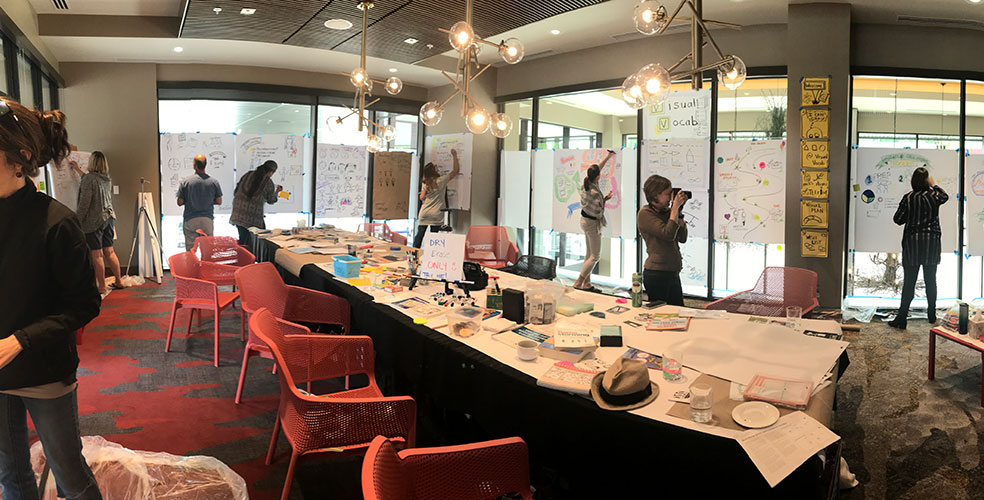
Drawing on Walls at the 2011 Graphic Facilitation Workshop in Rossland, B.C.
It’s been 2 weeks since the Graphic Facilitation workshop ended in Rossland, B.C (July 13-15, 2011). What have I learned that I will take with me in the future and can share with you? Here are a few of my reflections:
The workshop was a full 2.5 days of learning, practice and sharing ideas with a diverse range of fantastic people. While the workshop may have ended, the community is strong with active postings and sharing on our community Facebook Page (Rosviz10), Flickr (search rosviz) and Twitter (#rosviz). It’s amazing to see the back and forth and ongoing support of each others’ work.
Graphic facilitation, recording and using visuals helps me (and us) to crystallize our ideas. It’s a method within the facilitation toolbox to get people to focus and deal with the overload of ideas and information out there. It’s true that often an image speaks a thousand words. As Nancy likes to say, “We are making the invisible visible.”
Small things make a big difference when communicating with visuals. For example a little shading, a few shapes, and choosing a great colour palette make the visual pop and grab peoples’ attention.
Technology could help strengthen the future of graphic recording.As more and more people use iPad’s and other devices with drawing technology, I believe we will see more use of visuals in mainstream work.
Our workshop created an incubator for risk taking. Each person took risks in their own way. For some it was the art, for others it was telling a story and for others it may have been sharing their feedback. The workshop setting and group vibe created a safe place for people to step out of their comfort zone and try new things.
During the workshop, 2010 workshop participant Sylvia Currie, took on the role of ‘social reporter’. This video captures the essence of the workshop really well!
Violette Clark (workshop participant) also created a blog post and likely there are more. This is a call to all workshop participant’s to share your blogs if you posted something (use the comments feature, thanks!).
If you are on Flickr, Twitter, Facebook or other sites and looking to find posts – use rosviz as your search term. As twitter posts change so quickly, our #rosviz tweets are archived here.
If you know others who want to learn about graphic facilitation and graphic recording, please stay in touch and let us know. If we can gather a critical mass, we may be able to do this next year….it really is so much fun!
Before signing off, parting words to those who participated…..practice when you can, continue learning and use the community for support and inspiration!
Thank you again to all the workshop participants in 2010 and 2011, co-organizers/ supporters and to those who followed along via social media.
This is a re-post from Social Reporter Sylvia Currie and her blog “Webbed Feet“.
Thanks to Sylvia, I will be posting several links in the coming days to workshop interviews, videos, photos and blog posts!
Enjoy!!
Welcome sign by Michelle Laurie
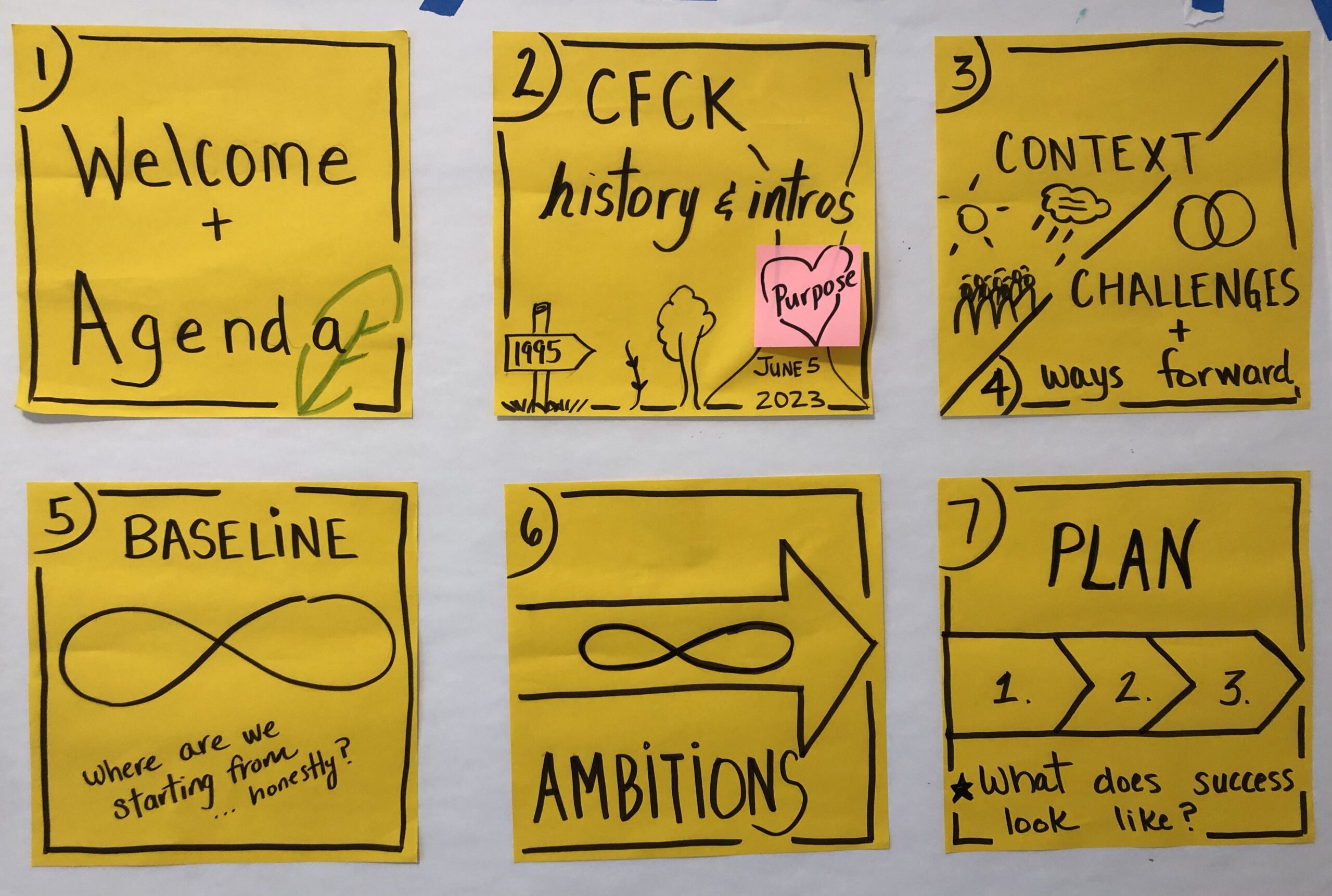
Our workshop agenda
Yesterday we arrived in Rossland, British Columbia from a variety of locations for the 2nd annual Graphic Facilitation workshop. A few of us did some prep work to get ready for the kick of graphic jam — hanging paper, prepping the floor space with plastic to catch chalk dust, and throwing open the curtains to let the natural light in.
It was exciting to put names to faces and learn about the various backgrounds and reasons for coming to the 3-day workshop. The first activity was a visual introduction. In 5 minutes the 20 participants came up with drawings that gave us a lot to talk about! We toured the room and participants described what they saw. Not your traditional round robin intros!
Violette Clark creating her visual introduction
Next Nancy made sure we warmed up properly and became aware of space around us by using our whole bodies. BIG circles! Rockin’ straight lines!
From there Nancy introduced participants to basic concepts around lettering, spacing, colour, and everything else that emerged from the group. One thing I really appreciate about Nancy White’s teaching style is that she uses the work of participants to point out different styles, design principles, impact of colour, use of space, and so on. We don’t always work through all skills and concepts systematically. By the end of the evening graphic jam we were talking about what works, what frustrates us, what we’re curious about… because we had plenty of time to experiment.
Yes we can! Close up of drawing by Sara Davis
We’re capturing bits and pieces that will give you a glimpse of what happens in the #rosviz graphic facilitation workshop. On to day 2!
A quick hello to say I am now tweeting thanks to the fine folks from #NV11 and #OCE2011 such as @bxmx and @ToriKlassen. I am still learning however so far I have been using tags such as:
#adaptation – climate change adaptation
#KM – knowledge management
#NV11 – Northern Voice
#Etug – another great event that was in Nelson and used graphic recording
#rosviz – a graphic facilitation workshop I host in Rossland July 13-15
It’s still new but looking forward to ongoing tweets! You can follow me at @Mklaurie
I will post more as I learn more. So far there have been benefits particularly around crowd sourcing knowledge, sharing quick information and event specific information (real time sharing). If you have a specific use or learning about tweeting, please let me know via the comments below.
Our graphic recording from #Etug keynote by @cogdog in Nelson, B.C. June 2, 2011
It’s been an exciting month for me as a novice visual practitioner. I owe a lot of this to taking the advice of Nancy White who told the students of our graphic facilitation workshop last year to simply ‘step forward’ and start drawing when opportunities arise. It’s a bit scary however after the first line is drawn on the paper it seems to come together.
Above is a graphic recording created by myself (@Mklaurie) along with two colleagues Sylvia Currie (@currie) and Rachael Roussin (@beetgreens) during the keynote of Alan Levine on the topic of Amazing Stories and Openess at #ETUG 2011. This was the first recording any of us had ever done for a keynote in public
As lead up to this fun event, Sylvia Currie and I gave a talk at Northern Voice in Vancouver on the topic of Visual Thinking. Approximately 60 people put their pens to paper to illustrate themselves in visuals with minimal text. The room was buzzing and energy levels were high. The best part was having people practice in Moose Camp (open space) and seeing them get out of their seats to co-draw in the room. Thanks to everyone who partook – it was a lot of fun and very inspiring. Below are a few pics from the experience.
Drawing on Walls session at Northern Voice 2011
Drawing on Walls together at Moose Camp at Northern Voice 2011
Participatory graphic from Moose Camp sessions, Northern Voice 2011
I continue to be inspired by the power of visuals to make more meaning from the work we do and the world we live in. Furthermore, it helps for retaining information, creating shared understandings and having fun!
Have you ever collaborated with someone yet didn’t feel like it was quite collaboration? Perhaps you received a contribution or a comment or an input that was interesting yet didn’t make a substantive difference to the end product? I feel the word collaboration is used loosely and should be reserved for times when all contributors are needed to create the outcome. If this isn’t the case, maybe the input should be labelled differently such as contribution, cooperation, or commenting by colleagues.
This blog post from Cloudhead is a good start on differentiating terms we use in the world of working together:
“When collaborating, people work together (co-labor) on a single shared goal.
Like an orchestra which follows a script everyone has agreed upon and each musician plays their part not for its own sake but to help make something bigger.
When cooperating, people perform together (co-operate) while working on selfish yet common goals.
The logic here is “If you help me I’ll help you” and it allows for the spontaneous kind of participation that fuels peer-to-peer systems and distributed networks. If an orchestra is the sound of collaboration, then a drum circle is the sound of cooperation. “
I would add to this that “To Collaborate” is to contribute to an end goal in a way that could otherwise not be reached without that collaboration. Hence, collaboration can help create efficiencies of work (rather than increase work load) and bring new ideas to the end product which often means a stronger more robust product as well.
The Asian Development Bank has recently released “Guidelines for Knowledge Partnerships”, a report prepared by Heather Creech of IISD and myself. This is a major step forward in our thinking on how to set up and manage partnerships that are primarily for the purposes of the generation and exchange of knowledge. We built the guidelines around the OECD DAC criteria for evaluation (Relevance, Effectiveness, Efficiency, Impact and Sustainability), together with identifying building blocks and success factors.
We hope those of you currently working with partners, or building more formal networks and consortia of organizations will find these guidelines helpful.